


What protects from Tuberculosis when HIV takes out your CD4 cells?
Review written by: Roshni Kadam

Tuberculosis, caused by Mycobacterium tuberculosis (Mtb), remains the leading cause of death from a single infectious agent, with 1.3–1.5 million deaths annually. An estimated two billion people carry latent Mtb infection (LTBI), contained within granulomatous lesions. The risk of reactivation rises sharply with immunosuppression, most notably HIV coinfection, whose hallmark is the loss of CD4+ T cells. This creates a paradox. CD4+ T cells are considered central to TB control, yet the immunological correlates that maintain latency in their absence remain undefined. The authors had previously shown that BCG vaccination prevents dissemination of contained lymphatic Mtb even when CD4+ T cells are depleted, which raised the question this study addresses: which immune cells mediate that protection? The work was led by Andreas Kupz at the Australian Institute of Tropical Health and Medicine, James Cook University, in collaboration with Selvakumar Subbian at the Public Health Research Institute, Rutgers New Jersey Medical School.
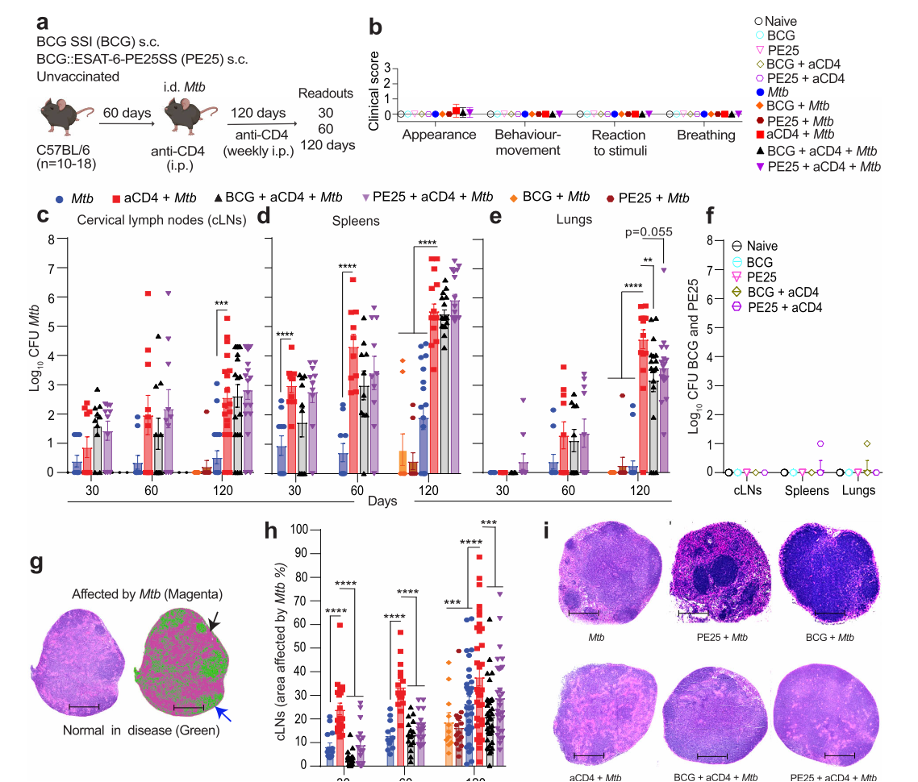
This study demonstrates that vaccination with BCG or BCG:ESAT-6-PE25SS did not reduce bacterial burden in the cervical lymph nodes or spleen relative to anti-CD4-treated mice. What it prevented was spread: lung CFU and pathology were significantly reduced, and in some cases, dissemination was entirely blocked. The same held across mesenteric lymph nodes, liver and bone marrow. Protection therefore operates as containment rather than clearance the bacteria remain, but they stay confined. The depletion experiments identify which cells enforce that confinement. Depleting both CD4+ and CD8+ T cells caused rapid, lethal dissemination to the lungs, with kinetics matching Rag1⁻/⁻ mice. Now what is a Rag1⁻/⁻ mice? Rag1⁻/⁻ mice lack the Recombination Activating Gene 1, so they have no mature T cells and no mature B cells. B cells could not compensate double depletion was equally fatal in wild-type mice with an intact B cell compartment and in B cell-deficient muMT mice, and transferring B cell-depleted lymph node cells still protected. In contrast, when CD4+ T cells alone were depleted, CD8+ T cells were sufficient to maintain containment and prevent lung spread. Taken together, vaccine-mediated protection in a CD4-deficient host is a barrier function rather than a bactericidal one, and CD8+ T cells are the cells that sustain it. However, recognition is not function. CD8+ T cell effector capacity was never directly measured there is no cytokine, cytotoxicity or degranulation data and the one panel assessing cytotoxic gene expression showed no significant differences, a null result the authors attribute to the lack of single-cell resolution in the spatial platform. The proposed mechanism is therefore spatial: CD8+ T cells positioned at the lesion edge prevent bacterial escape. That is an inference from proximity measurements, not a demonstrated effector function, and the authors acknowledge as much, proposing single-cell spatial transcriptomics as the way forward.
---
READ MORE: Miranda-Hernandez S, Kumar M, Henderson A, Graham E, Tan X, Taylor J, Meehan MT, Ceja Z, Del Pozo-Ramos L, Pan Y, Tsui E, Donovan ML, Rentería ME, Flores-Valdez MA, Blumenthal A, Nguyen Q, Subbian S, Field MA, Kupz A. CD8+ T cells sustain vaccination-induced immunity against dissemination of contained tuberculosis in immunosuppressed hosts. Nat Commun. 2026 Mar 24;17(1):4476. doi: 10.1038/s41467-026-70911-4. PMID: 41876499; PMCID: PMC13187035.


